For a Dubai off-plan buyer asking which payment dates bind you, start with the executed Sales and Purchase Agreement (SPA), its schedules and any valid written amendments. Match each payment demand to the clause that sets the amount, trigger and deadline.
- The executed SPA and documents it incorporates set the payment terms. M&M’s Dubai developer profiles can help you assess a developer as part of the wider purchase decision.
- A reservation agreement may set obligations before the SPA is signed. Check how its payment is treated in the SPA.
- A calendar-date instalment and a construction milestone have different triggers. Follow the wording of the clause.
- A payment demand should match the SPA’s amount, trigger, notice period and effective due date.
- A project delay does not automatically change an instalment date. Read the payment, extension and force majeure clauses.
- Keep purchase-price instalments separate from registration, service and administrative charges.
Start with the executed SPA and its related documents
An off-plan purchase means buying a property before it is complete, with payments usually staged under an agreed schedule. The payment plan is the structure; the SPA is the contract that records which instalments you must pay, and when.
Read the signed SPA, its schedules and any documents it expressly incorporates. A marketing summary can explain the offer, but it does not replace the contractual payment terms.
M&M Real Estate’s off-plan properties in Dubai are curated investment opportunities, with assistance from initial consultation through handover and beyond. That support can help you review a proposed purchase alongside the documents that set its payment obligations.
Compare the SPA with the reservation agreement. Identify any payment due before signing the SPA, the condition attached to it and whether the SPA credits it towards the purchase price.
Check how the SPA allows its terms to change. A signed amendment or side letter may change a payment date if it meets the contract’s amendment requirements. A verbal assurance or informal message does not, by itself, show that those requirements have been met.
The purchase stages are set out in M&M’s guide to buying off-plan property in Dubai.
Find the exact amount, due date and notice period
For each instalment, match the stated amount or percentage to its due date and calculation basis. Check whether the SPA calculates the payment from the purchase price, an adjusted balance or another amount named in the contract.
Read the due-date wording closely. It may set a calendar date, a period after an event or a deadline that takes effect only after formal notice.
Then read the notice period beside the due-date clause. Check when the period starts, how the SPA counts it and whether it addresses weekends or public holidays. The date a demand arrives may not be the date the payment period begins.
Follow the payment method in the SPA and allow for processing time. If the contract requires funds to reach an account by the deadline, sending a transfer on that date may not be enough.
Illustrative calculation: Multiply the purchase price by the instalment percentage stated in the SPA.
- Use the purchase price stated in the SPA.
- Apply the instalment percentage stated in the SPA.
- Multiply the purchase price by the instalment percentage to calculate the amount.
This example shows the arithmetic only. Use the calculation basis and instalment terms written in your own SPA.
Separate calendar instalments from construction milestones
A calendar-date instalment falls due on the date or after the period stated in the SPA. Visible construction progress does not change that trigger unless the clause makes progress a condition.
A construction-linked instalment depends on the milestone wording. The trigger may be reaching a construction stage, receiving a certificate, getting formal notice or another documented event.
If the clause requires certification or notice, compare the payment demand with that evidence. Check when the document was issued or the notice took effect, then apply the payment period in the SPA.
Do not treat a milestone instalment as due only because a calendar date has passed if the SPA makes payment conditional on a documented construction event. A separate example of how to assess a named plan appears in M&M’s review of Beyond’s 30/70 payment plan; the dates that bind a buyer still come from that buyer’s contract.
| Instalment type | What triggers payment | What to match in the demand |
|---|---|---|
| Calendar-date instalment | The date or period written in the SPA | The stated date, amount and any notice period |
| Construction milestone | The defined construction event and any required evidence or notice | The milestone document, its effective date and the payment period |
Check the demand against the trigger and project records
Match the demand to the SPA clause, instalment amount, trigger and effective due date. If any part differs, ask the developer in writing to identify the clause and calculation it relied on.
For a construction-linked payment, request the evidence specified in the contract. Compare its date with the notice and the wording that starts the payment period.
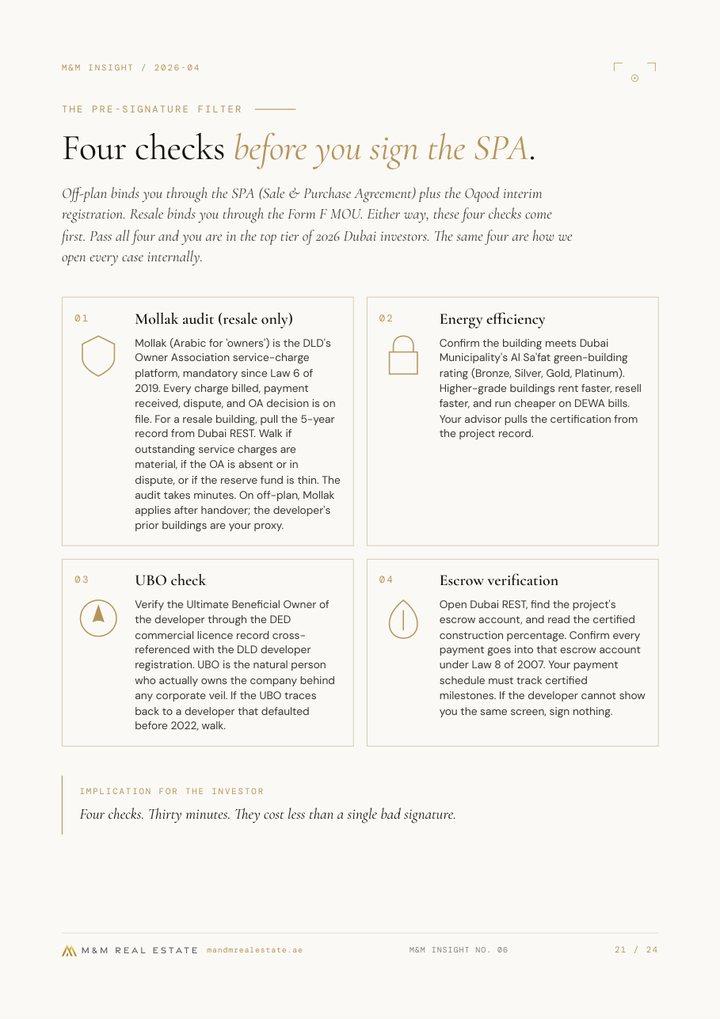
Project records and the project escrow account provide a separate check on project status and payment routing. Escrow is the project account used for off-plan buyer funds; Dubai Land Department information on escrow accounts and off-plan projects explains the system. Escrow safeguards do not set your contractual due date.
Use the payment instructions in the SPA or a formally issued update. If account details change, verify them through an established developer contact before transferring funds.
Understand what delays mean for handover and later payments
A delayed project does not automatically suspend a calendar-date instalment. Read the SPA’s payment, extension and force majeure clauses to see what the specific delay changes.
Keep the estimated completion date, the SPA’s completion provisions and each instalment due date separate. Treat each separately; a change to one does not change the others unless the SPA provides for it.
For a handover balance or post-handover instalment, identify the precise trigger, amount and notice period. Map each payment to the relevant SPA clause instead of treating all payments around completion as one balance.
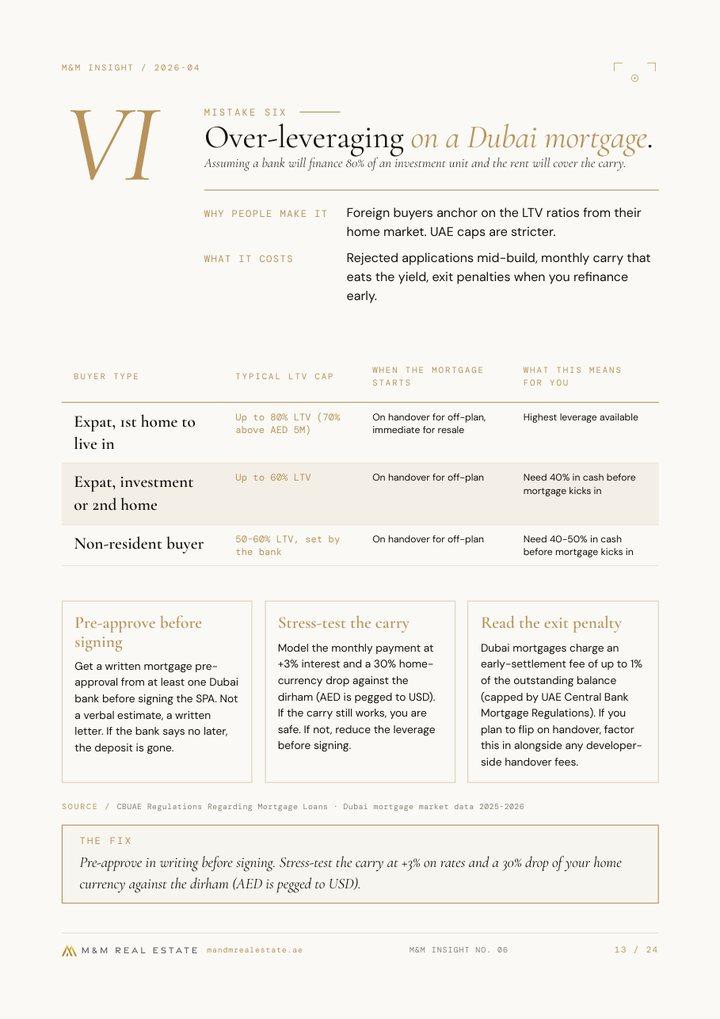
If you plan to use a mortgage for the handover balance, allow for lender eligibility checks and processing time. Mortgage approval does not, on its own, extend the SPA deadline.
Respond carefully to a disputed demand or missed payment
If a demand appears inconsistent with the contract, keep the SPA, payment schedule, notices, milestone evidence, calculation and correspondence together. Ask in writing for the clause and event supporting the amount and due date.
Read the default clause for any grace period, required default notice, interest or other remedy. A disputed demand or project delay does not automatically pause the process set out in the SPA.
Separate purchase-price instalments from registration, service and administrative charges. Identify the document and due date that apply to each charge.
M&M’s off-plan villas for sale in Dubai are sourced with a focus on waterfront communities. This is relevant context for buyers comparing villa opportunities and the payment structure attached to each purchase.
Where contract wording or a proposed remedy is unclear, speak with a UAE property lawyer before withholding payment or relying on an informal waiver. This is general information, not tax or legal advice. M&M Real Estate advisors can discuss the broader off-plan investment context.
Further reading for the wider investment decision
Payment dates are one part of a purchase decision. These M&M pages cover related areas, ownership and investment questions:
- Dubai Golden Visa through property
- Dubai areas by investment goal
- Dubai rental yields, costs and tax
- Tax on Dubai property
- Dubai property investment guide
- Dubai and Abu Dhabi location guides
- Dubai investment guides and resources
- Bay Estate by Nakheel investment case
- The Yards Plaza office investment case
- Comparing Emaar and DAMAC on the public record
- Al Jaddaf Waterfront location guide
- JVC investment guide
- Dubai Hills Estate guide
- Dubai population growth and city planning
- How Dubai property crowdfunding works
- The Yards Plaza investment case
What to do before the next instalment
Put the SPA clause, amount, trigger, notice date and effective due date in one schedule. Attach the supporting certificate or notice for each milestone payment, and keep separate entries for charges outside the purchase price.
For a review of your payment schedule and the wider investment context, speak with an M&M advisor. An advisor will go through your budget, timeline and shortlist with you.
this article is general information and not tax, legal or financial advice, and returns are not guaranteed.


Does Oqood registration itself make an instalment due?
Oqood is the DLD’s off-plan registration, and registration records the off-plan sale. It does not by itself set an instalment date; the SPA determines whether registration is a payment trigger.
Can I sell my Dubai off-plan property before handover?
A resale before handover depends on the SPA’s transfer terms and the applicable transfer process. Read the transfer clause for any developer approval, outstanding payment or document requirements before agreeing a sale.
Can I pay an instalment early if the SPA gives a later due date?
Ask the developer how it will allocate an early payment and whether it changes the timing of later instalments. Get the answer in writing so your account record reflects the agreed treatment.
What should I do if a payment request gives bank details different from the SPA?
Pause the transfer and contact the developer using a contact method already established in your purchase records, not details supplied only in the new request. Ask for formal confirmation of the payment instructions and have your bank check the beneficiary details before sending funds.
How does off-plan work in Dubai?
You buy before completion, with payment obligations governed by the signed SPA.
What is a payment plan in Dubai?
A payment plan is the structure for paying the purchase price in instalments, often tied to calendar dates or construction milestones. The signed Sales and Purchase Agreement sets the amounts, triggers and deadlines that apply.
Ten off-plan mistakes
The ten mistakes overseas buyers make most, and how to check each one before you sign. 24 pages. Free by email.