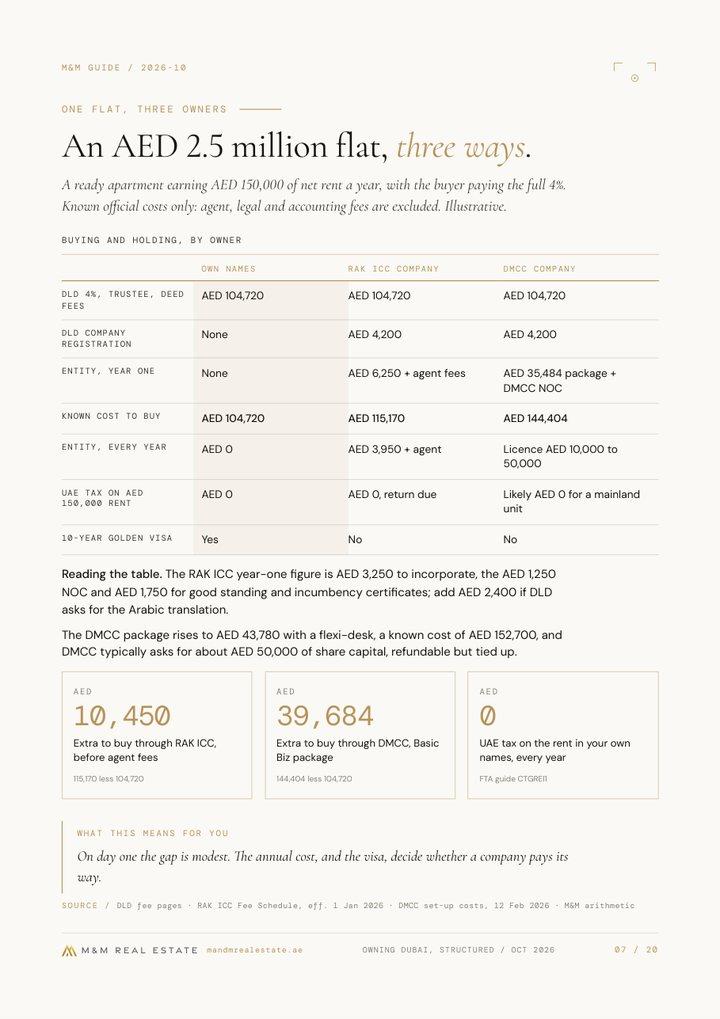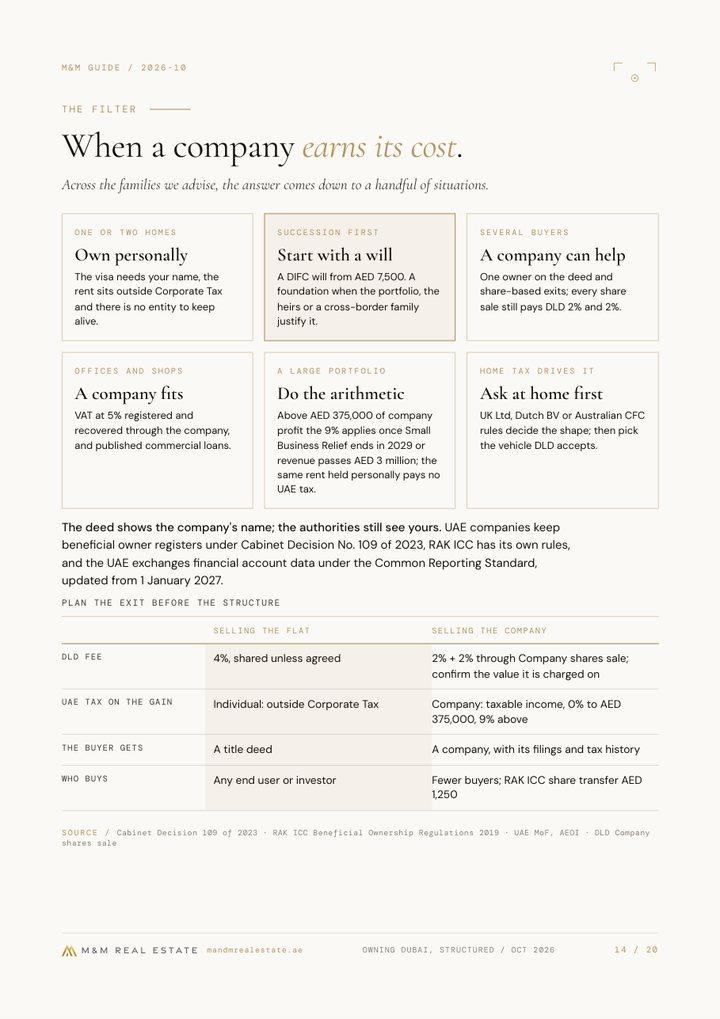
Corporate selling and buying property in Dubai starts with eligibility: the company, title and intended use must fit the relevant registration route. At M&M Real Estate, we advise investors to settle that question before they pay to establish a company or sign a Sale and Purchase Agreement (SPA).
- Choose the property and intended use before choosing a company structure.
- Get written guidance on company and title eligibility before committing funds.
- Agree corporate approvals, finance conditions and signing authority before the SPA.
- Keep company funds, property income and records separate throughout ownership.
- Plan early for the sale route, succession and any change of shareholders.
Check company and property eligibility before committing
Start with the proposed property, its location and what the company will do with it. The rules for registering a title can differ by property and company structure, so a licence to conduct business does not by itself establish that an entity can hold a particular property.
Before paying to establish or adapt a company, ask the relevant company registry and Dubai Land Department (DLD) for written guidance on eligibility and the registration route. Check the title restrictions, required developer or authority No Objection Certificate (NOC), and whether the intended use is permitted before signing the SPA.
Use a clear sequence: confirm eligibility, secure corporate approvals and financing terms, then agree the SPA and transfer requirements. Our property guidance for Dubai buyers covers residential and commercial opportunities, while the developer profiles can help you assess who is delivering a project.

Source: Dubai Public Debt Management Office
Choose the ownership structure around the investment plan
A mainland company is set up to conduct business in the UAE market. A free zone company is licensed within a particular free zone. In both cases, verify the licence and the property ownership permission as separate requirements.
A holding company or special purpose vehicle (SPV) can separate an asset from other activities, while adding governance, accounting and ongoing compliance work. It does not automatically protect every asset or improve access to finance.
| Structure | What to check |
|---|---|
| Mainland company | Whether the entity and its licence suit the property and intended activity. |
| Free zone company | Whether its jurisdiction permits the proposed property ownership and registration route. |
| Whether the DLD and relevant registry will accept it for the specific title. | |
| Holding company or SPV | Whether asset separation justifies the additional governance and filing work. |
Compare company and personal ownership against the planned use, tax position, lender requirements, succession plan, asset separation and exit route. Ask a qualified UAE legal and tax adviser to assess the specific structure. Our guide to property crowdfunding also explains how pooled property investment differs from owning property through a company.
For Dubai Marina, assess residential rental data separately from office or other commercial income.
Match the property title and use to the company
Freehold ownership conveys ownership of the property. Leasehold grants rights for a defined term. Check the actual title and, for leasehold, the remaining term. An area name alone does not establish what rights the buyer receives.
Confirm that the specific property can be registered to the proposed entity. Freehold-area rules, a developer’s process or the company’s jurisdiction may affect eligibility. For area comparisons, compare Al Jaddaf Waterfront, Jumeirah Village Circle and Dubai Hills Estate. The population growth analysis provides further context for assessing demand drivers.
For a commercial purchase, Grade-A business district offices are commercial offices in established business hubs. Compare the location, building grade and leasing readiness with the expected occupier or tenant profile. For a specific office example, read the Investment Case for The Yards Plaza by BEYOND.
For Business Bay, assess residential rental data separately from expected office income.
Assess whether the asset is ready or off-plan and whether the company will occupy, lease or resell it. Each choice affects timing, funding, approvals and contract obligations. Our Bay Estate Investment Case gives an example of reviewing a named development, while the Emaar and DAMAC comparison covers developer due diligence.
Prepare approvals, documents and finance before the SPA
Prepare the company trade licence, constitutional documents, ownership and beneficial-owner details, authorised signatory identification, and board or shareholder resolutions. The exact set depends on the entity and transaction.
Make signing authority clear and consistent across resolutions, powers of attorney and transaction documents. Ask the lender about its entity, property, valuation, guarantee and document requirements before agreeing a completion timetable. Company ownership by itself does not secure mortgage approval.
Review the SPA, payment schedule, NOC requirements, title restrictions and conditions precedent together. Agree what happens if finance or an approval is delayed or refused. For an off-plan purchase, read the payment plan analysis alongside the contract and funding schedule.
Budget for transfer fees alongside the deposit and other transaction costs.
Our Dubai investment resources can support your preparation, while the relevant company registry, DLD and lender should provide written transaction-specific requirements.
Plan the holding period, records and tax treatment
Keep company and property funds separate. Retain records of acquisition costs, financing, rental income, expenses, approvals and ownership decisions. These records support accounting and make a later sale or review easier.
Assess tax and filing obligations by company structure and property activity, including whether the asset is occupied, let or held for resale. the investor’s home country may still tax them, so a tax adviser should assess the full position. This is general information, not tax or legal advice.
Track licensing, accounting and filing duties throughout ownership, and assign someone to maintain the company and property records. For an investment held through a company, review tax on Dubai property with a qualified UAE tax adviser, alongside any home-country advice.
Ready-to-operate office spaces suit buyers assessing immediate use or leasing. The office page describes these spaces as offering immediate leasing opportunities and early income generation. Compare the leasing plan and operating costs with expected income; a headline rent figure is not the investment return.
For individual residency planning, review the Dubai Golden Visa property guidance as a separate question from company ownership and property registration.
Plan the sale route before you need to exit
A direct sale transfers the property title. A share transfer changes ownership of the company that holds the property, so the buyer’s diligence also covers the company’s liabilities, accounts, contracts and governance.
For either route, review the title, financing or discharge requirements, corporate approvals, beneficial ownership records, and any NOC or transfer restrictions early. Compare net proceeds, tax and legal consequences, buyer requirements and execution steps with qualified advisers before choosing the route.
Keep acquisition, leasing, expense and approval records organised throughout ownership. For off-plan holdings, Dubai off-plan properties are selected by location, developer track record and growth potential, with direct developer access and assistance through the process.
Build succession and delay planning into the structure
Decide how death, incapacity or a shareholder change should affect control of the company and property. Align the company documents with that plan and take succession advice for the relevant jurisdictions.
Before a transaction, identify the approvals, signatories, lender conditions and title matters that could delay completion. Set milestones, assign responsibility and obtain written status on outstanding approvals or finance conditions if the timetable slips. Agree any revised timetable or contractual response with legal advisers.
Review the structure and records before resale or a change in use. A structure chosen for acquisition may not suit the eventual buyer, financing or exit. For investors considering how developers and projects fit their plans, our area guide and Dubai Hills Estate guide provide further location context.
See also: The Yards Plaza by BEYOND, City of Arabia Offices, M&M.
What to do before you commit
Set out the property, intended use, ownership structure and preferred exit route. Then obtain written eligibility guidance, agree the company approvals and finance conditions, and budget the transfer and holding costs before signing.
An M&M advisor will go through your budget, timeline and shortlist with you. Speak with an M&M advisor about corporate buying or selling property in Dubai.
Figures are past data from the sources named; this article is general information and not tax, legal or financial advice, and returns are not guaranteed.


Can a company buy a residential property in Dubai?
Yes; the key is whether the proposed entity is accepted for that property’s title and registration route.
Can a company buy an off-plan property in Dubai?
Yes, where the developer and registration process accept the company as buyer; have its authorised signatory ready for the SPA.
Can a company use a Dubai property for its employees or directors?
It may, if the title, building rules and company activity allow it; record who will occupy the property and why.
What happens to a company-owned Dubai property when a shareholder dies?
The property stays with the company; the shareholder’s interest is handled under the company documents and applicable succession process.
Can the company that owns a Dubai property change its shareholders without selling the property?
Yes; the company can remain the registered owner after a share transfer, subject to any required approvals and clearances.
Owning Dubai property through a company
Ownership structures, corporate tax and succession, explained for overseas owners. 20 pages. Free by email.