At M&M Real Estate, we compare an off-plan payment schedule with the dates your capital is available, then test each payment against your other costs.
Compare the dates, triggers and full cash commitment
- What does a payment plan set? The dates or construction stages when the buyer pays the agreed purchase price.
- How should you compare plans? Put each amount, due date and contractual trigger in one calendar.
- Which costs sit outside the instalments? Allow for registration, finance, handover and ownership costs.
- Can rent cover later instalments? Include possible letting gaps and ongoing costs before relying on rental income.
- Can a mortgage fund the handover balance? Ask a lender about eligibility, valuation and borrowing capacity before you rely on one.
How Dubai off-plan payment plans work
A payment plan sets when the buyer pays the purchase price and what makes each instalment due. It changes the timing of cash leaving your account, so compare the dated amounts and contractual triggers alongside the agreed price.
A construction-linked plan ties instalments to building milestones. A time-linked plan sets instalments against dates in the agreement, and a calendar date may remain in force if construction is delayed.
A post-handover plan moves part of the payment commitment into the ownership period. Include those later instalments alongside service charges and other costs that start when you take ownership.
A headline split needs to be read with the payment schedule and the sale and purchase agreement.
A ratio is not a substitute for the schedule. Use the agreement to identify the exact stage attached to each part of the split.
For an explanation of the purchase process, registration and escrow, read M&M’s off-plan guide. A separate analysis of a Beyond 30/70 payment plan gives another example of how a different split changes the cash schedule.
Turn the instalment schedule into a cash-flow calendar
Record every payment in date order, from booking to the last post-handover instalment. For each one, write down the amount, due date, contractual trigger and the evidence or notice that starts the payment period.
- Enter the booking payment and any other initial amount due on signing.
- Add every construction instalment and its milestone or calendar date.
- Record the handover balance and each later payment separately.
- Set the expected date when funds will be available beside every outgoing payment.
Keep costs outside the developer’s schedule in separate lines. These can include Dubai Land Department registration, Oqood (the DLD’s off-plan registration), conveyancing or administration costs, mortgage expenses, handover costs and service charges.
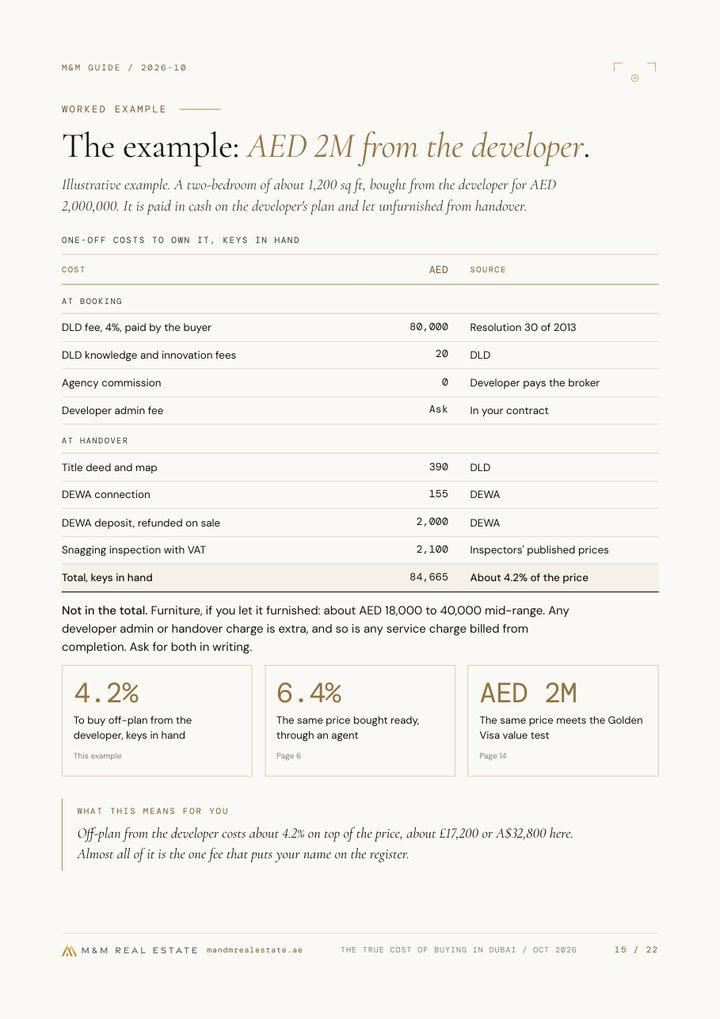
The DLD transfer fee is 4% of the sale value; budget for it alongside the initial purchase funds.
Map instalments against money you can access on the relevant dates, such as salary, investment proceeds or scheduled transfers. Keep a separate reserve for costs that fall between instalments or arrive before a planned transfer clears.
For a construction-linked instalment, find the milestone evidence, notice method and payment deadline in the sale and purchase agreement. A forecast date alone does not prove that the contractual milestone has been reached, so retain the notice and supporting records.
Compare the full cash commitment at every stage
Compare each plan by the amount due at booking, during construction, at handover and afterward. Record the cumulative amount paid at each point as well, because similar headline splits can create different peaks in cash demand.
Paying a larger share earlier ties up cash sooner. Compare that commitment with the funds you want to keep available for emergencies, other investments and costs that may arise during construction.
The handover dates place the stated balances at different points in time, while the split percentages alone do not show the dates when cash is due. A longer schedule can still leave later payments overlapping with service charges or other financial commitments.
For project-specific context, read M&M’s Investment Case for The Yards Plaza. Compare project details with the payment schedule and sale and purchase agreement.
Match the schedule to your income and intended use
If you receive regular income, compare recurring time-linked instalments with the money left after normal commitments. Keep a cash buffer instead of allocating every expected surplus to the property.
If an instalment depends on a bonus, business proceeds or the sale of another asset, assess the likely net amount and timing before treating it as available. A schedule that brings a large payment forward can create a shortfall if those funds arrive late.
Rental income starts only after the home is ready, available to let and occupied. Allow for possible letting gaps, service charges and other ownership costs before deciding how much a post-handover instalment rent could cover.
Rental considerations are covered in M&M’s guide to Dubai property rentals and yields. For broader context, read M&M’s Dubai real estate investment guide, which places off-plan decisions within an investment plan.
Handover timing also affects the purpose of the property. A buyer planning to live in the home needs funds for moving and setup, while an investor should budget for the period between completion and any rental income.
Stress-test handover funding, delays and currency movements
If a mortgage may fund the handover balance, speak with a lender about eligibility, valuation and likely borrowing capacity before relying on it. The bank’s assessment and the property’s valuation determine the funding route, so keep another source of funds available if the loan falls short.
Run a downside cash-flow version with income temporarily reduced, handover later than expected or exchange rates moving against the currency you hold. Set a reserve that can absorb a plausible shortfall without relying on the next expected payment arriving on time.
Read the agreement to see whether each instalment is tied to a calendar date or a construction milestone, and what the contract says if completion is delayed. A delay does not automatically move every payment date, so use the clause that applies to each instalment.
When assessing a completion balance, test it against available savings and a funding route discussed with a lender.
Project analysis and support through handover are part of M&M’s off-plan property service. Use the payment schedule, rather than the split alone, to identify the cash needed at each stage.
Read the agreement for payment, default and resale terms
In the sale and purchase agreement, match every instalment to its exact date or construction trigger, required evidence, notice method and payment deadline. Keep copies of notices, statements and payment records so you can track what the developer has requested and what you have paid.
Read the late-payment and default clauses, including any notice period, charges and remedies. A missed instalment can trigger consequences set out in the contract, so identify those terms before committing to a schedule.
Check the assignment or resale clauses for developer consent, fees and any payment or registration milestones. Those conditions determine when a buyer can transfer their position, so an exit plan needs to follow the written terms.
Read the escrow, delay, cancellation and refund clauses together. Dubai Law No. 8 of 2007 provides for escrow arrangements; qualified advice can help explain how the SPA applies to your circumstances.
For developer context, read M&M’s developer profiles.
See also: Dubai Golden Visa, Best Areas Invest Dubai 2026, Dubai Property Tax What Should New Real Estate Investors Know, Locations, Resources, Bay Estate by Nakheel, Dubai Islands: Investment Case, Emaar Vs Damac Developer Comparison, Al Jaddaf Waterfront Guide 2026: Prices and Metro, Jvc, Dubai Hills, Dubai Population Growth, Real Estate Crowdfunding In Dubai, The Yards Plaza.
Build your next step around the cash calendar
Before reserving a unit, put the booking payment, construction instalments, handover balance, later payments and separate costs in one calendar. Ask the developer to identify each trigger and notice period, then compare those dates with available funds and your reserve.
An M&M advisor will go through your budget, timeline and shortlist with you. Speak with an M&M advisor about matching the payment schedule to your funds.
this article is general information and not tax, legal or financial advice, and returns are not guaranteed.


Can I make an early or extra payment towards a Dubai off-plan property?
The sale and purchase agreement and the developer’s payment instructions govern early or additional payments. Ask how the developer will allocate the funds, whether the next instalment changes and how the revised balance will appear on your statement.
Can a developer change the payment schedule after the sale and purchase agreement is signed?
The signed agreement and any variation accepted by the parties set the payment terms. A later sales message or marketing schedule does not itself record a change to the signed agreement.
Does paying instalments into an escrow account guarantee that a project will be completed?
No. Dubai Law No. 8 of 2007 provides escrow controls for project funds, while completion still depends on the project and the remedies set out in the agreement. Read the escrow information alongside the clauses for delay, cancellation and refund.
Can I pay Dubai off-plan instalments in a currency other than AED?
The developer’s payment instructions and banking arrangements determine which currencies it accepts. If your funds are held in another currency, compare the conversion rate, transfer charges and arrival date with the AED amount due.
The true cost of buying in Dubai
Every fee from reservation to resale, with a worked example on an AED 2 million home. 22 pages. Free by email.